

Pain near the belt line can be difficult to identify. It may feel as though it is coming from the lumbar spine, the hip, or the muscles around the pelvis. In some patients, the actual source is sacroiliac joint pain from one of the joints that connects the lower spine to the pelvis.
Because the area is close to several other pain-producing structures, SI joint pain symptoms may overlap with sciatica, a herniated disc, facet joint irritation, muscle strain, or a condition inside the hip. That is why lower back and hip pain should be evaluated according to its pattern, triggers, examination findings, and effect on movement rather than location alone.
This guide explains how the sacroiliac joint works, what may irritate it, how clinicians distinguish it from other causes of pain, and which sacroiliac joint treatment options may be considered. The information is educational and cannot replace an individualized medical evaluation.
What Is the Sacroiliac Joint?
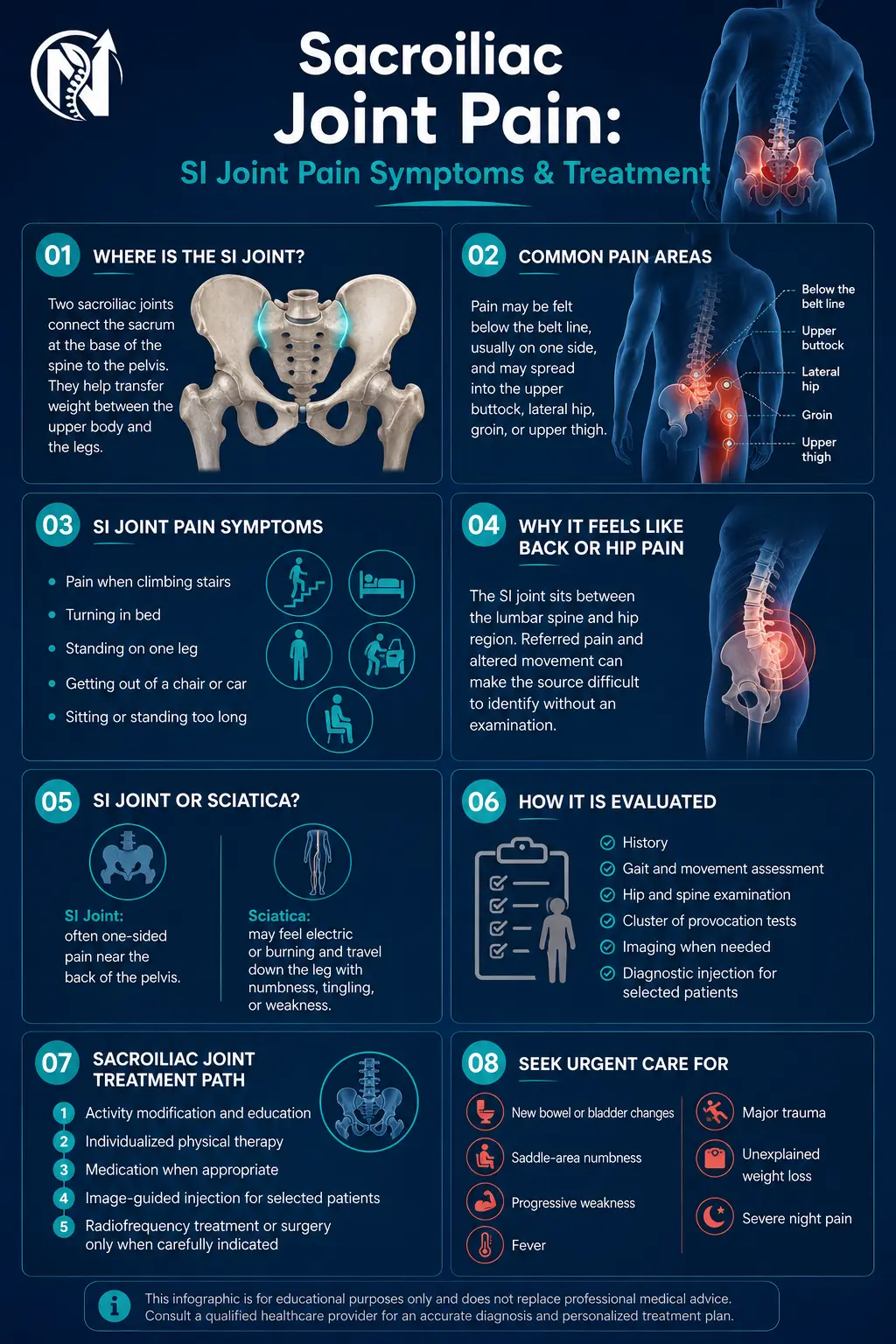
The sacroiliac joints, often called the SI joints, sit on the right and left sides of the pelvis. Each joint connects the sacrum the triangular bone at the base of the spine—to the ilium, which is part of the pelvis.
These joints move only a small amount, but they play an important role in transferring weight and force between the upper body and the legs. Strong ligaments and surrounding muscles help stabilize the pelvis as you walk, climb stairs, stand from a chair, lift, or shift your weight from one side to the other.
Sacroiliac joint pain can develop when the joint or the tissues around it become irritated, inflamed, too stiff, or insufficiently stable. The term “SI joint dysfunction” is often used for mechanical problems, while “sacroiliitis” refers more specifically to inflammation of one or both SI joints. The symptoms may overlap, but the underlying cause can influence the treatment plan.
Where Is Sacroiliac Joint Pain Usually Felt?
Many patients point to a spot just below the waist and slightly to one side of the spine, near the upper part of the buttock. The discomfort may remain localized or spread into the buttock, side of the hip, groin, or upper thigh. One side is often more painful than the other, although both sides can be affected.
The location can make sacroiliac joint pain look like an ordinary back problem. Northeast Medical’s lower back pain treatment guide provides a broader overview of muscular, disc-related, joint-related, and nerve-related causes of persistent back pain.
A common description is a deep ache near the “dimple” area of the low back. Other patients report a sharp catch when standing, turning in bed, stepping out of a car, or putting more weight on the painful side. These variations are one reason lower back and hip pain cannot be diagnosed from a single symptom.
What Are the Most Common SI Joint Pain Symptoms?
SI joint pain symptoms vary according to the cause, the structures involved, and the activities that load the pelvis. Pain may begin after a fall, awkward lift, repetitive sport, pregnancy, or a change in walking mechanics. It can also appear gradually without one clear event.
Common SI joint pain symptoms may include:
- Aching or sharp pain in the upper buttock
- Increased discomfort after prolonged sitting or standing
- Pain when turning over in bed or lying on the affected side
- Pain during transitions, such as getting out of a chair or car
- Pain on one side of the low back, usually below the belt line
- Pain when climbing stairs, taking a long step, or standing on one leg
- Discomfort that spreads toward the lateral hip, groin, or upper thigh
- A feeling of stiffness, instability, or reduced confidence during movement
Some SI joint pain symptoms are triggered by asymmetrical loading. Carrying a child on one hip, stepping onto a curb, crossing the legs, or repeatedly shifting weight to one side may increase discomfort. Symptoms alone are not enough to confirm the source because several spine and hip conditions can cause a similar pattern.
Why Can the SI Joint Cause Lower Back and Hip Pain?
The SI joint sits directly between the lumbar spine and the hip region. Pain from this area can be referred into nearby tissues, meaning the location where a person feels discomfort may not be identical to the structure producing it.
Lower back and hip pain may also develop because the pelvis, lumbar spine, and hip joints work as a connected system. If one area becomes painful or loses normal mobility, the surrounding muscles may tighten and movement patterns may change. This can place additional stress on the opposite SI joint, the lumbar facets, the gluteal muscles, or the hip.
This overlap does not mean that every person with pain in both areas has an SI joint problem. A careful examination is important because true hip-joint disorders, lumbar disc problems, nerve compression, fractures, and inflammatory conditions may need a different approach.
What Can Cause Sacroiliac Joint Pain?
There is not always one identifiable cause. In some patients, the joint becomes painful after a clear injury. In others, repeated loading, reduced muscle control, arthritis, or inflammation may contribute.
Injury or sudden force
A fall onto the buttocks, a motor vehicle collision, a forceful twisting event, or an awkward heavy lift can stress the joint and surrounding ligaments. Pain may begin immediately or become more noticeable as inflammation and protective muscle tension develop.
Repetitive or uneven loading
Running, jumping, climbing, prolonged single-leg standing, and sports that involve repeated rotation can increase shear and torsional forces through the pelvis. A leg-length difference, altered gait, or weakness around the hips and trunk may also change how force is distributed.
Pregnancy and the postpartum period
Pregnancy can change pelvic mechanics as body weight, posture, gait, and ligament flexibility change. Some people develop symptoms during pregnancy or after delivery. A clinician may adapt exercise, support, and sacroiliac joint treatment recommendations to the patient’s stage of pregnancy or recovery.
Arthritis and inflammatory disease
Osteoarthritis may affect the SI joints over time. Inflammatory conditions such as ankylosing spondylitis, psoriatic arthritis, and other forms of spondyloarthritis may cause sacroiliitis. Inflammatory pain may be associated with prolonged morning stiffness, alternating buttock pain, improvement with movement, or symptoms outside the spine.
Prior spine or pelvic changes
Previous lumbar fusion, hip surgery, trauma, or changes in mobility can alter how forces move through the pelvis. This does not prove that the SI joint is the pain source, but it may be relevant during the history and physical examination.
How Is SI Joint Pain Different From Sciatica or Hip Pain?
Distinguishing the source matters because the right plan depends on what is actually generating the symptoms. Several clues can guide the evaluation, but no single clue provides a diagnosis.
SI joint pain versus sciatica
Sciatica usually describes nerve-related pain that travels from the lower back or buttock into the leg. It may feel electric, burning, shooting, or sharp and may be accompanied by numbness, tingling, or weakness. Review the companion guide to sciatica vs lower back pain for a detailed comparison of localized pain and nerve-root symptoms.
Sacroiliac joint pain can refer into the thigh, but prominent neurological changes, pain traveling below the knee, or clear weakness may make a lumbar nerve problem more concerning. A neurological examination can help check strength, sensation, and reflexes.
SI joint pain versus a herniated disc
A herniated disc may irritate a spinal nerve and cause radiating leg pain, numbness, tingling, or weakness. Northeast Medical’s herniated disc pain treatment guide explains the symptoms, evaluation process, and nonsurgical options that may be considered when a disc is involved.
SI joint pain versus a hip-joint problem
Pain from inside the hip joint is often felt more prominently in the groin or front of the thigh. It may be associated with reduced hip motion, clicking, catching, or pain when putting on shoes and socks. SI-related pain more commonly centers near the back of the pelvis, but the patterns can overlap.
Because lower back and hip pain can come from more than one structure at the same time, the evaluation may need to examine the lumbar spine, hips, pelvic girdle, gait, and lower-extremity nerves.
How Is Sacroiliac Joint Pain Diagnosed?
Diagnosis begins with a detailed history. A clinician may ask where the pain started, whether it is one-sided, what movements make it worse, whether it travels, and whether there are neurological, inflammatory, or systemic symptoms.
The physical examination may include:
- Palpation around the back of the pelvis
- Hip and lumbar-spine range-of-motion testing
- Observation of posture, gait, and weight shifting
- Strength, reflex, and sensation testing when nerve involvement is possible
- A group of SI joint provocation tests that gently load the joint in different directions
Individual provocation tests are not definitive by themselves. Clinical guidance commonly uses a cluster of tests because several positive responses are more informative than one isolated maneuver.
X-rays, MRI, or CT scans may be ordered to look for arthritis, inflammation, fracture, infection, or another condition. Imaging is not always able to prove that a mechanically abnormal-looking SI joint is the source of pain. Findings must be interpreted together with the symptoms and examination.
For selected patients, an image-guided injection of local anesthetic into the SI joint may help confirm whether the joint is producing the pain. The response to a diagnostic injection may also help guide later sacroiliac joint treatment decisions.
When Are Symptoms Urgent?
Most SI-region pain is not an emergency. However, urgent medical evaluation is important when pain follows major trauma or occurs with fever, unexplained weight loss, a history of cancer, severe night pain, new bowel or bladder changes, numbness around the groin or saddle area, or progressive weakness.
These symptoms can point to conditions that require prompt testing and should not be assumed to be routine sacroiliac joint pain. Severe pain during pregnancy, postpartum pain with fever, or inability to bear weight also warrants timely medical attention.
What Are the Main Sacroiliac Joint Treatment Options?
The most appropriate sacroiliac joint treatment depends on whether the problem is mechanical, inflammatory, traumatic, pregnancy-related, or part of another medical condition. Treatment also depends on how long symptoms have been present and how much they affect walking, sleep, work, and daily activity.
Activity modification and symptom management
Short-term changes may include avoiding the movements that repeatedly provoke pain while maintaining comfortable activity. Heat or ice may help some patients. Over-the-counter medication may be considered when medically appropriate, but patients with kidney, liver, stomach, bleeding, heart, pregnancy, or medication-interaction concerns should speak with a clinician before using it.
Physical therapy and rehabilitation
Rehabilitation often focuses on pelvic and trunk stability, hip and gluteal strength, mobility, posture, and movement mechanics. The program should be individualized because stretching an already unstable area or strengthening through sharp pain may not be appropriate.
A structured plan may address tight hip flexors, hamstrings, piriformis muscles, or thoracolumbar tissues while strengthening the abdominal, gluteal, and pelvic-support muscles. Manual therapy may be combined with exercise when appropriate. Consistent exercise is usually more important for long-term function than relying on a passive treatment alone.
Pelvic support
A pelvic belt may be helpful for selected patients, especially during pregnancy or the postpartum period, when additional external support can reduce strain. The fit and timing should be discussed with a qualified clinician or therapist.
Image-guided sacroiliac joint injection
If conservative care is not enough, a clinician may consider an image-guided injection. A future Northeast Medical guide to sacroiliac joint injection will explain the diagnostic and therapeutic purposes, preparation, procedure, recovery, and limitations in detail.
An injection may contain local anesthetic to help evaluate the source of pain and corticosteroid to reduce inflammation when appropriate. Relief can vary, and an injection should be part of a broader plan rather than viewed as a guaranteed or permanent solution.
Radiofrequency ablation
For carefully selected patients who respond to diagnostic blocks, radiofrequency ablation may be considered to reduce pain signals from nerves serving the SI joint region. The planned Northeast Medical article will explain candidacy, preparation, recovery, benefits, and limitations.
Treatment for inflammatory sacroiliitis
When an inflammatory arthritis is suspected, evaluation may involve a rheumatologist. Treatment can differ from care for mechanical dysfunction and may include condition-specific medication in addition to exercise and symptom management.
Surgery
SI joint fusion is generally reserved for a small group of patients with persistent, carefully confirmed pain that has not improved with appropriate conservative and less invasive care. A surgical consultation should review the diagnosis, alternatives, expected recovery, and potential risks.
What Can Patients Do During Daily Activities?
Small movement changes can sometimes reduce irritation while a treatment plan is underway. Patients may be advised to avoid repeatedly standing with all their weight on one leg, use support when getting into or out of a car, take shorter steps during a flare, and change position before prolonged sitting or standing becomes painful.
Sleeping with a pillow between the knees or under the knees may improve comfort for some people. Lifting technique, workstation setup, footwear, and gradual return to activity may also matter. These strategies should be adjusted if they increase pain or conflict with instructions from a treating clinician.
The goal of sacroiliac joint treatment is not simply to avoid movement. It is to identify tolerable movement, restore strength and control, and gradually return to daily activities as safely as possible.
When Should You See a Pain Management Specialist?
Consider an evaluation when pain lasts more than a few weeks, repeatedly returns, interferes with sleep or mobility, or has not improved with appropriate conservative care. Northeast Medical’s guide on when to see a pain management specialist explains other signs that a more detailed assessment may be useful.
A specialist may help determine whether the source is the SI joint, lumbar spine, hip, nerve, muscle, or a combination of structures. The goal is to build a diagnosis-led plan instead of selecting a procedure based only on the location of pain.
Patients can also review the pain conditions treated by Northeast Medical and the practice’s pain management treatments to understand the types of concerns evaluated and the treatment categories that may be discussed after an examination.
Frequently Asked Questions
Can sacroiliac joint pain travel down the leg?
Yes. Sacroiliac joint pain may spread into the buttock, groin, lateral hip, or thigh. Pain that travels below the knee with numbness, tingling, or weakness may be more suggestive of nerve involvement, although symptom patterns can overlap. A physical and neurological examination can help clarify the source.
Can an MRI diagnose SI joint dysfunction?
MRI can be useful when a clinician is evaluating inflammation, infection, fracture, or another condition, but imaging does not always identify the source of mechanical SI pain. Diagnosis usually depends on the history, examination, and sometimes a diagnostic injection.
Is walking good for SI joint pain?
Gentle walking may be helpful when it does not increase symptoms, but distance, speed, hills, and stride length may need to be adjusted. During a flare, shorter and more frequent walks may be better tolerated than one long walk. A therapist can help modify activity according to the diagnosis.
How long does SI joint pain take to improve?
Recovery varies. A recent mechanical irritation may improve with activity modification and rehabilitation, while persistent instability, arthritis, inflammatory disease, or pain after trauma may require a longer plan. Response to treatment and improvement in function are more useful than a fixed timeline.
What is the best sacroiliac joint treatment?
There is no single best option for every patient. First-line care often combines education, activity modification, and individualized rehabilitation. Medication, injections, radiofrequency procedures, treatment for inflammatory disease, or surgery may be considered for selected patients based on the confirmed cause and response to earlier care.
Local Pain Care in New York and New Jersey
Northeast Medical provides pain-management evaluation for patients in Brooklyn, Staten Island, Jersey City, Edison, and surrounding communities. Review the Northeast Medical office locations to find the practice location that works best for you.
During an evaluation, the physician can review the history, examine the spine, pelvis, hips, and nerves, and discuss whether further testing or a specific sacroiliac joint treatment pathway may be appropriate. Recommendations vary according to the diagnosis, medical history, insurance requirements, and individual goals.
If persistent lower back and hip pain is limiting walking, sleep, work, or normal activity, schedule a pain management appointment with Northeast Medical to discuss your symptoms and next steps.
Final Thoughts
Pain near the lower back, buttock, and hip can come from several structures. SI joint pain symptoms may resemble a muscle strain, sciatica, a disc problem, or pain from inside the hip, which makes self-diagnosis unreliable.
Sacroiliac joint pain is usually evaluated through the symptom pattern, a complete physical examination, and selective testing when needed. Once the likely source is identified, care may progress from rehabilitation and activity changes to injections or other procedures for appropriately selected patients.
The best sacroiliac joint treatment plan is one that addresses the underlying cause, supports function, and is adjusted according to the patient’s response. Seek urgent care for red-flag symptoms, and arrange a clinical evaluation when pain persists or limits daily life.