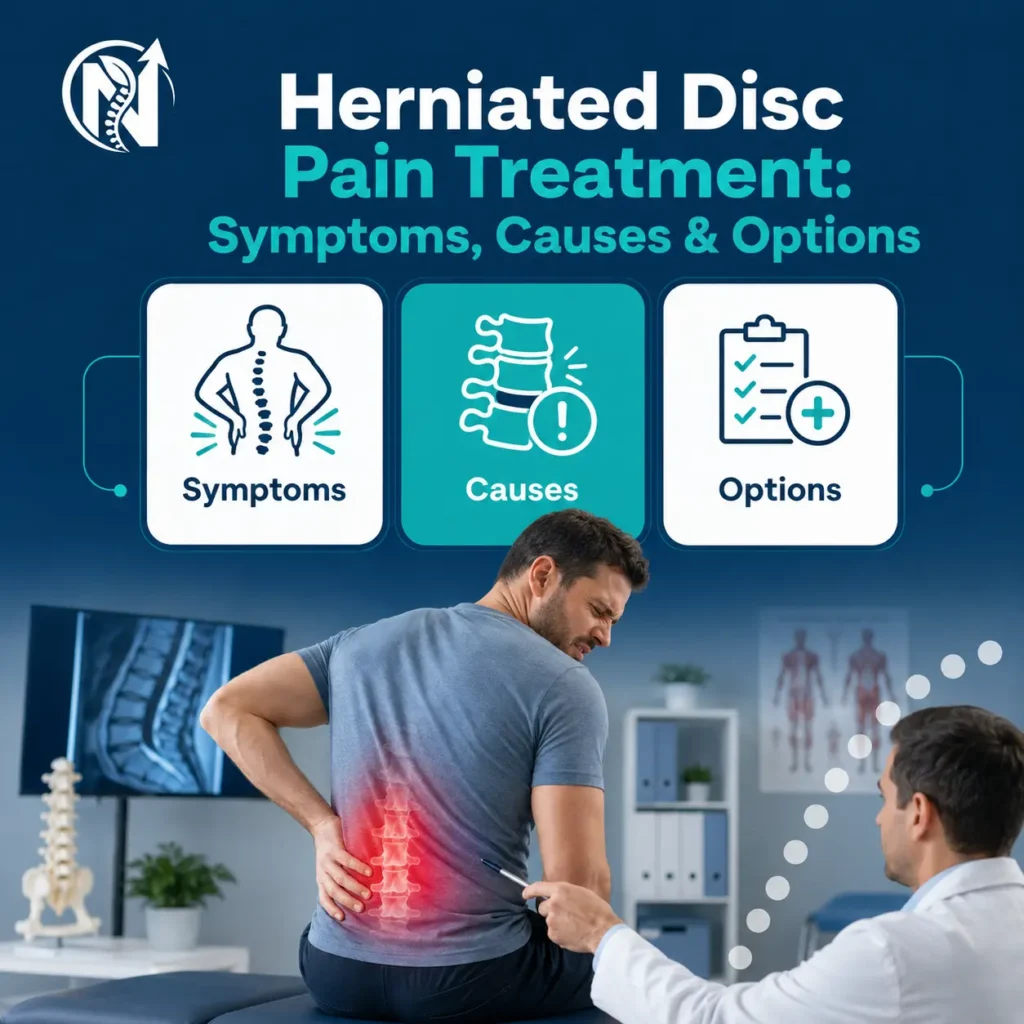
A herniated disc can cause anything from a localized ache to sharp pain, numbness, tingling, or weakness that travels into an arm or leg. Because symptoms vary, effective herniated disc pain treatment begins with identifying which part of the spine is involved, whether a nerve is irritated, and how the problem is affecting movement and daily life.
Some people search for herniated disc symptoms after an MRI report mentions a bulging or protruding disc. Others begin looking for slipped disc treatment because back or neck pain has persisted, returned, or started radiating. Imaging can provide useful information, but a scan alone does not show whether a disc finding is actually responsible for the symptoms.
This guide explains what a herniated disc is, common causes, how disc pain in lower back may differ from ordinary muscular pain, and which nonsurgical or surgical options may be discussed after evaluation. It also explains warning signs that should not wait for a routine appointment.
What Is a Herniated Disc?
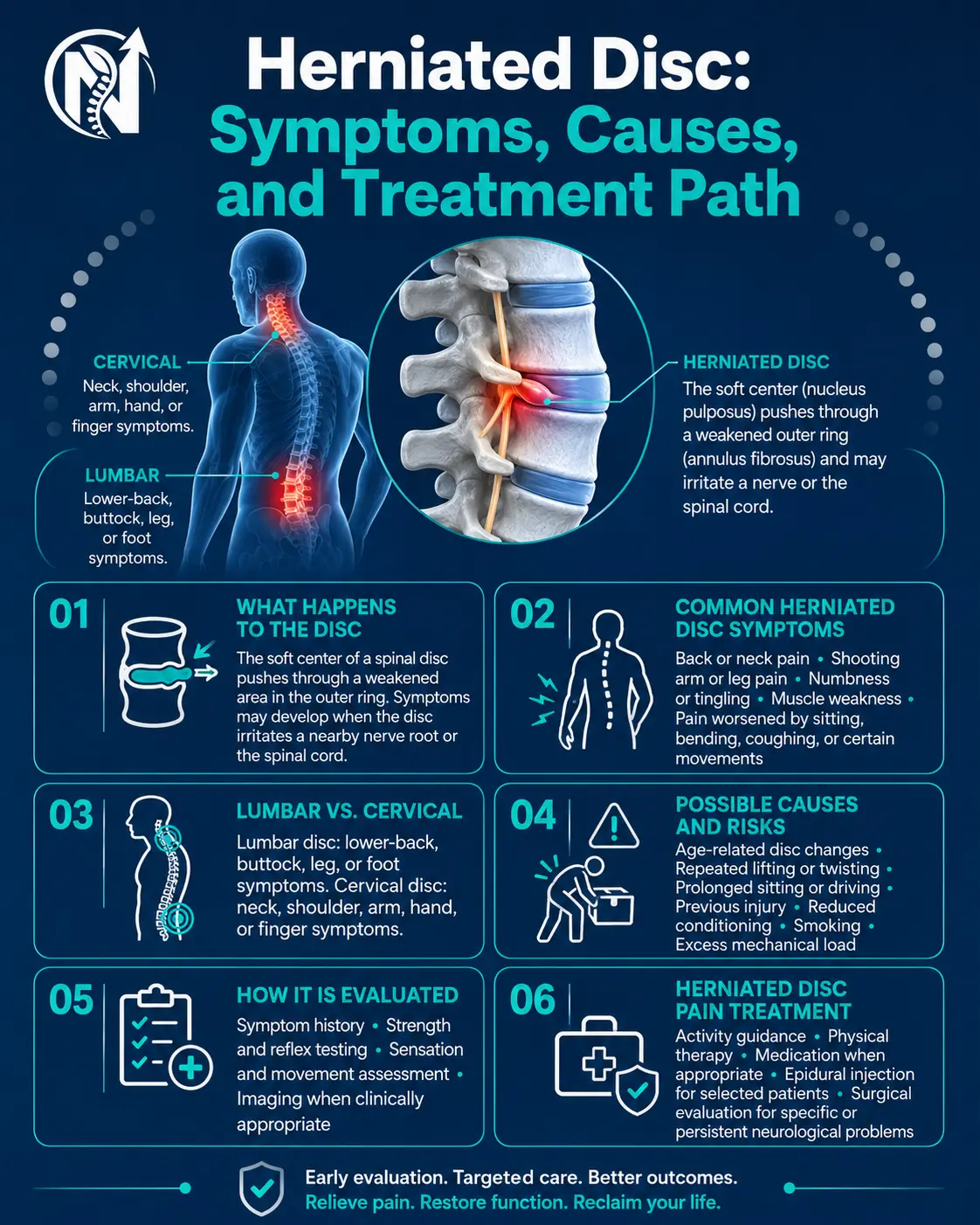
The spine is made of vertebrae separated by flexible discs that help absorb load and allow movement. Each disc has a softer center surrounded by a tougher outer ring. A herniated disc develops when part of the inner material pushes through a weakened or torn area of the outer ring.
The terms herniated disc, ruptured disc, and slipped disc are often used interchangeably in patient conversations, although the disc does not literally slip out of place. A disc can herniate in the lower back, neck, or less commonly the mid-back. Symptoms are more likely when displaced disc material irritates or compresses a nearby nerve root or the spinal cord.
A herniated disc does not always produce pain. Some disc changes appear on imaging in people who have no symptoms. For that reason, diagnosis should combine the history, examination, neurological findings, and imaging when imaging is clinically appropriate.
What Are the Most Common Herniated Disc Symptoms?
Herniated disc symptoms depend on the location and direction of the herniation, the amount of inflammation, and which nerve structures are affected. A lumbar herniation may cause lower-back and leg symptoms, while a cervical herniation may affect the neck, shoulder, arm, hand, or fingers.
Common herniated disc symptoms may include:
- Reduced tolerance for walking, standing, driving, sleeping, or working
- Pain traveling into one buttock and leg or into one shoulder and arm
- Numbness or tingling in the leg, foot, arm, hand, or fingers
- Aching, sharp, or burning pain in the lower back or neck
- Weakness in muscles supplied by the affected nerve
The intensity of herniated disc symptoms does not always match the size of the disc finding on an MRI. A relatively small herniation can be painful if it irritates a sensitive nerve root, while a larger finding may produce few or no symptoms in another person.
How Does Disc Pain in Lower Back Usually Feel?
Disc pain in lower back may remain centered around the lumbar spine, or it may be accompanied by pain that travels into the buttock, thigh, calf, or foot. Localized pain may feel deep, aching, or sharp and can become worse with sitting, forward bending, lifting, or repeated twisting.
When a lumbar nerve root is affected, leg pain may be more noticeable than the back pain. The pain may feel electric, burning, or shooting and can occur with numbness, tingling, or weakness. This radiating pattern is commonly described as sciatica.
Not every episode of disc pain in lower back is caused by a herniation. Muscles, facet joints, the sacroiliac joint, spinal stenosis, fractures, infection, and other conditions can produce overlapping symptoms. Review Northeast Medical’s lower back pain treatment guide for a broader discussion of lower-back causes, red flags, and treatment pathways.
Patients who are unsure whether symptoms are localized or nerve-related can also review the planned guide to sciatica vs lower back pain once it is published.
Lumbar and Cervical Herniated Discs Can Feel Different
Lumbar herniated disc
A lumbar herniated disc occurs in the lower spine. It may cause back pain, sciatica, numbness, tingling, or weakness in one leg or foot. The exact pathway depends on which lumbar or sacral nerve root is affected.
Cervical herniated disc
A cervical herniated disc occurs in the neck. It may cause neck pain, shoulder-blade pain, arm pain, numbness, tingling, or weakness in the arm or hand. In some cases, pressure on the spinal cord can affect balance, walking, hand coordination, or bladder function and requires prompt assessment.
What Causes a Herniated Disc?
Disc herniation can occur gradually as discs lose water content and flexibility with age, or it may follow a strain, awkward movement, fall, collision, or lifting injury. Often there is no single moment when the problem begins.
Factors that may contribute include:
- Age-related disc degeneration
- Repeated lifting, bending, pulling, or twisting
- Long periods of sitting or frequent driving
- A sedentary lifestyle and reduced core conditioning
- Using the back rather than the legs during heavy lifting
- Smoking, which is associated with faster disc degeneration
- Excess body weight, which increases mechanical load on the spine
- A history of physically demanding work or previous spine injury
Risk factors do not prove that a disc is the source of pain. They help the physician understand the clinical context and decide which examination findings or tests are most relevant.
How Is a Herniated Disc Diagnosed?
Diagnosis usually begins with a detailed history. A physician may ask where the pain begins, where it travels, how it feels, when it started, which activities worsen it, and whether there is numbness, tingling, weakness, balance difficulty, or a change in bladder or bowel control.
The examination may include:
- Checking sensation and reflexes
- Assessing spinal, hip, and shoulder mobility
- Testing strength in the arms, hands, legs, or feet
- Observing walking, balance, posture, and movement
- Using specific positions that may reproduce or relieve nerve symptoms
- Reviewing prior treatment, imaging, injuries, and medical conditions
MRI can show discs, nerve roots, and other soft tissues, but imaging is not automatically required for every new episode. The timing of imaging depends on symptom duration, neurological findings, warning signs, injury history, and whether the result is likely to change treatment.
If pain persists, keeps returning, or includes neurological changes, the article on when to see a pain management specialist can help patients understand when a more detailed evaluation may be appropriate.
Herniated Disc Pain Treatment Usually Starts Conservatively
For many patients, initial herniated disc pain treatment is nonsurgical. The goal is to reduce irritation, maintain safe movement, improve strength and function, and give the body time to recover. The plan should be individualized because medication safety, activity level, examination findings, and medical history vary from person to person.
Conservative options may include:
- Heat or cold for temporary symptom relief
- Gradual return to walking and normal activity as tolerated
- Brief activity modification while avoiding prolonged bed rest
- Education about lifting, sitting, sleeping, and workstation habits
- Over-the-counter or prescription medication when medically appropriate
- Physical therapy focused on mobility, posture, core strength, and movement mechanics
Slipped disc treatment should not mean complete inactivity for an extended period. AAOS and AANS patient guidance generally describe conservative, nonsurgical care as the usual starting point for most patients without emergency findings. The appropriate pace of activity should be discussed with a clinician when pain is severe or neurological symptoms are present.
Effective herniated disc pain treatment also depends on tracking function, not only pain intensity. Improvements in walking, sleep, sitting tolerance, strength, and the ability to complete daily tasks can help show whether the plan is working.
When May an Epidural Steroid Injection Be Considered?
If pain radiates into an arm or leg and does not improve enough with appropriate conservative care, an epidural steroid injection may be considered for selected patients. The medication is delivered near an irritated spinal nerve with the goal of reducing inflammation and providing temporary relief.
An injection does not repair the disc itself, and results vary. It may create a window in which rehabilitation and normal activity are easier, but candidacy depends on the symptom pattern, examination, imaging when available, medical history, and previous treatment.
A future Northeast Medical guide to epidural steroid injection will explain preparation, the procedure, recovery, benefits, limitations, and questions to ask before treatment.
Explore Northeast Medical’s current pain management treatments to understand the types of interventional care that may be considered after an evaluation.
When Is Surgery Considered?
Most people with a lumbar herniated disc do not automatically need surgery. Surgery may be discussed when severe or disabling symptoms continue despite an appropriate period of nonsurgical care, or when neurological loss is severe, progressive, or associated with an emergency condition.
A common operation for a lumbar herniated disc is discectomy or microdiscectomy, in which the surgeon removes the portion of disc material pressing on a nerve. Cervical procedures differ depending on the level involved, spinal stability, the location of compression, and whether the spinal cord is affected.
Slipped disc treatment decisions should weigh the expected benefits, limitations, risks, recovery, and alternatives. A pain management physician may coordinate with a spine surgeon when surgical evaluation is appropriate, while continuing to help manage symptoms and function.
Warning Signs: When to Seek Urgent Medical Care
Most herniated discs are not medical emergencies. However, severe nerve or spinal-cord compression can threaten neurological function.
Seek urgent or emergency medical care for:
- New loss of bladder or bowel control
- Severe symptoms affecting both leg
- Back or neck pain after serious trauma
- Numbness in the groin, inner thighs, or saddle area
- Rapidly worsening weakness in an arm, hand, leg, or foot
- Difficulty starting urination or inability to empty the bladder
- Pain with fever, a significant recent infection, or a history of cancer
- New difficulty walking, major balance changes, or loss of hand coordination
These symptoms should not wait for a routine office appointment. Emergency services or an emergency department can evaluate time-sensitive causes.
When to Schedule a Non-Urgent Evaluation
Arrange an evaluation when pain lasts longer than expected, returns repeatedly, interrupts sleep, limits work or mobility, or travels into an arm or leg. Persistent numbness, tingling, or weakness also deserves assessment, even when the pain itself is manageable.
A clinician can help determine whether the symptoms match a disc problem, another spinal condition, a joint problem, a muscle injury, or a different nerve disorder. That distinction guides whether physical therapy, medication, an injection, further testing, or a surgical consultation is reasonable.
Northeast Medical’s pain conditions treated page provides an overview of spine, nerve, joint, and muscle-related concerns evaluated by the practice.
Frequently Asked Questions
Can a herniated disc heal without surgery?
Many people improve with time and nonsurgical care. Symptoms may decrease as inflammation settles and the herniated material changes or is gradually resorbed. Recovery time varies, and persistent or worsening neurological symptoms need reassessment.
Is a bulging disc the same as a herniated disc?
The terms describe different disc shapes, but they are sometimes used loosely. A bulging disc generally extends more broadly, while a herniation is more focal. The more important question is whether the finding corresponds with the patient’s symptoms and examination.
What is the best slipped disc treatment?
There is no single best slipped disc treatment for everyone. Treatment depends on whether symptoms are localized or radiating, the presence of weakness or numbness, symptom duration, medical history, examination findings, and response to previous care.
Can disc pain in lower back cause leg weakness?
Yes. If a lumbar disc irritates or compresses a nerve root, disc pain in lower back may occur with leg or foot weakness. New or worsening weakness should be evaluated promptly.
Do I need an MRI for herniated disc symptoms?
Not always. A clinician may first use the history and examination. MRI is more likely when symptoms persist, there are significant neurological findings, warning signs are present, or the result may change the treatment plan.
How long does herniated disc pain treatment take?
The timeline varies. Some episodes improve over days or weeks, while others need a longer period of rehabilitation, medication management, injections, or surgical evaluation. Follow-up should focus on both symptom change and functional recovery.
Local Herniated Disc Evaluation in New York and New Jersey
Northeast Medical evaluates spine-related pain, nerve symptoms, and mobility concerns for patients in Brooklyn, Staten Island, Jersey City, Edison, and nearby communities. A local office can make follow-up visits, imaging review, rehabilitation planning, and procedure appointments easier to coordinate.
Review Northeast Medical’s office locations to choose the most convenient practice location. Patients can then schedule a pain management evaluation when persistent pain, radiating symptoms, or reduced function is affecting daily life.
Final Thoughts
A herniated disc can cause localized back or neck pain, radiating nerve pain, numbness, tingling, or weakness. Because imaging findings and symptoms do not always match, diagnosis should be based on the full clinical picture.
The right herniated disc pain treatment may begin with activity guidance, physical therapy, and medication when appropriate. Selected patients may also be considered for an epidural injection, while surgery is generally reserved for specific neurological findings or persistent disabling symptoms that do not respond to appropriate nonsurgical care.
If you are experiencing persistent herniated disc symptoms, recurring disc pain in lower back, or arm or leg symptoms that may require slipped disc treatment, schedule an appointment with Northeast Medicalto discuss your symptoms and appropriate next steps.