

Lower back discomfort is common, but not every painful back is caused by the same problem. Some people feel a localized ache after lifting, sitting for a long time, or moving awkwardly. Others describe burning, electric, or shooting pain that starts in the lower back or buttock and travels into one leg.
Understanding sciatica vs lower back pain can help you describe your symptoms more clearly and recognize when a nerve may be involved. Lower back pain often stays around the lumbar spine, although it can spread into the hips or buttocks.
Sciatica is a pattern of nerve-related symptoms that usually follows the path of a nerve root into the buttock, thigh, calf, or foot. The difference matters because the right evaluation and treatment depend on the source of the pain. If you have back pain going down the leg, numbness, tingling, burning, or weakness, the symptoms may require more than ordinary home care.
A medical evaluation can help determine whether you are experiencing sciatic nerve pain, muscular pain, joint-related pain, or another condition.
Sciatica vs Lower Back Pain: The Main Difference
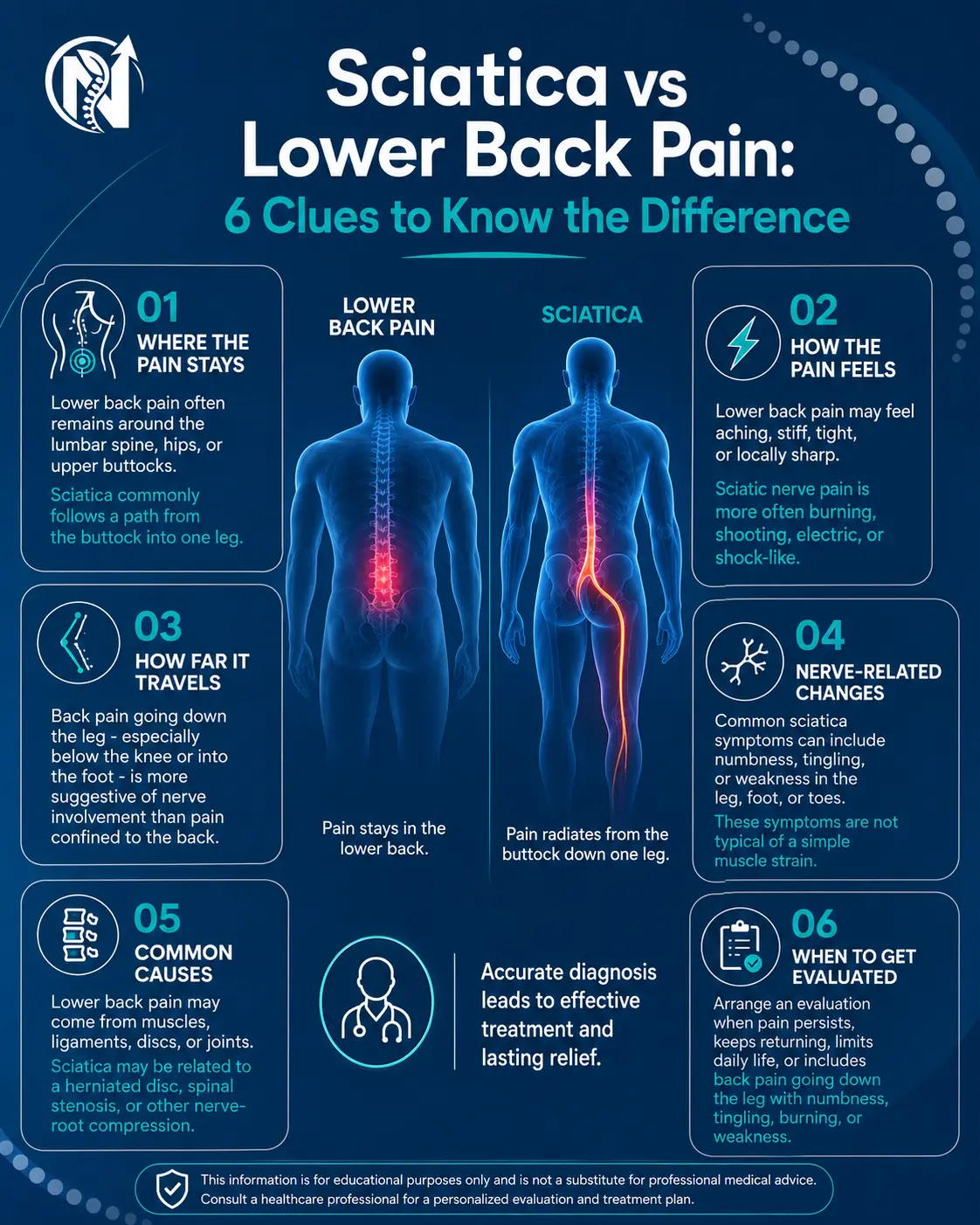
The simplest way to compare sciatica vs lower back pain is to ask where the symptoms are felt and whether there are signs of nerve irritation.
Lower back pain is a broad symptom. It may come from muscles, ligaments, discs, spinal joints, the sacroiliac joint, or other structures. It may feel dull, sore, tight, stiff, or sharp. The pain can remain in one area or spread into the buttocks and hips without following a clear nerve pathway.
Sciatica is more specific. It refers to pain and other neurological symptoms associated with irritation or compression of nerve roots that contribute to the sciatic nerve. Sciatic nerve pain often affects one side and may travel from the lower back or buttock into the back or side of the thigh, calf, foot, or toes.
What Does Lower Back Pain Usually Feel Like?
Lower back pain can develop suddenly after a strain or injury, or gradually because of repeated stress, reduced mobility, arthritis, or age-related spinal changes. The discomfort may be mild and temporary, or it may persist and interfere with sitting, standing, lifting, walking, sleep, or work.
Typical lower back pain may include:
- Pain that becomes worse with bending, lifting, twisting, or prolonged activity
- Stiffness after sitting, sleeping, or remaining in one position
- Pain that stays mainly in the back, hips, or upper buttocks
- A dull or aching sensation across the lower back
- Tenderness when the muscles are pressed
- Muscle tightness or spasms
Localized back pain can still be significant, especially when it lasts for several weeks or keeps returning. However, pain that stays in the back without numbness, tingling, weakness, or a clear path down the leg is less typical of sciatica. For a broader review of causes and warning signs, see the guide to lower back pain treatment.
What Does Sciatica Usually Feel Like?
Sciatica is not a diagnosis by itself. It is a group of symptoms caused by irritation, inflammation, or compression affecting a nerve root in the lower spine. A herniated disc is one common cause, but spinal stenosis, degenerative changes, bone spurs, and vertebral slippage can also contribute.
Common sciatica symptoms include:
- Pain that may become worse with sitting, coughing, sneezing, bending, or certain movements
- Pain beginning in the lower back or buttock and traveling down one leg
- Leg pain that is more noticeable than the back pain
- Numbness or tingling in the leg, foot, or toes
- Sharp, burning, electric, or shooting pain
- Weakness in the leg or foot
The exact pattern depends on which nerve root is affected. Some people experience sciatic nerve pain mainly in the buttock and thigh, while others feel symptoms below the knee or into the foot. Not every person has all the same sciatica symptoms, and the intensity can range from irritating to severely limiting.
Why Back Pain Going Down the Leg Deserves Attention
Back pain going down the leg can indicate that a spinal nerve is irritated, but the pattern needs to be evaluated carefully. The location, quality, and distance of the pain provide useful clues.
Pain that follows a narrow pathway from the buttock into the calf or foot, especially when combined with tingling, numbness, or weakness, is more suggestive of nerve-root involvement. In contrast, pain from muscles, the hip, or the sacroiliac joint may spread into the thigh without producing the same neurological changes.
Because back pain going down the leg can have more than one cause, it should not automatically be labeled as sciatica. A clinician may assess your strength, reflexes, sensation, walking pattern, range of motion, and the movements that reproduce or relieve the symptoms.
Common Causes of Sciatic Nerve Pain
Sciatic nerve pain usually begins when a nerve root in the lumbar spine becomes irritated or compressed.
Common possible causes include:
- Spinal stenosis: Narrowing around spinal nerves can cause pain, tingling, cramping, or weakness, especially when standing or walking.
- Degenerative changes: Arthritis, disc loss, or bone spurs may reduce space around a nerve.
- Injury or inflammation: Trauma or irritation can trigger or worsen nerve symptoms.
- Spondylolisthesis: A shifted vertebra may compress nearby nerves.
- Herniated disc: Disc material may press on or inflame a nerve root.
The cause of sciatic nerve pain cannot always be identified by symptom location alone. Imaging findings also need clinical context because some disc or arthritic changes can appear in people who have no symptoms.
Could Leg Pain Be Something Other Than Sciatica?
Yes. Not all leg pain that begins near the back or hip is caused by the sciatic nerve. Conditions affecting the hip joint, sacroiliac joint, muscles, tendons, peripheral nerves, or circulation can produce overlapping symptoms.
Possible clues that another source may be involved include pain concentrated in the groin, pain that is strongly reproduced by hip movement, localized tenderness, swelling, skin-color changes, or symptoms that do not follow a recognizable nerve pattern. These clues do not provide a diagnosis by themselves, but they help guide the examination.
This is another reason the comparison of sciatica vs lower back pain should be based on a full symptom pattern rather than one phrase. A pain management specialist can evaluate whether back pain going down the leg is coming from the spine, a joint, a muscle, or a different nerve.
How Doctors Evaluate Sciatica Symptoms
The evaluation usually begins with a detailed history. Your physician may ask when the pain started, whether it came on after an injury, where it travels, what makes it worse, and whether you have numbness, tingling, or weakness.
A physical and neurological examination may check:
- Reflexes
- Sensation
- Walking and balance
- Leg and foot strength
- Spinal and hip movement
- Whether specific positions reproduce sciatic nerve pain
Imaging is not automatically required for every new episode. Depending on the duration and severity of the sciatica symptoms, the examination findings, previous treatment, and the presence of warning signs, a physician may recommend an X-ray, MRI, CT scan, or other testing.
If pain has lasted longer than expected, limits daily function, or has not improved with appropriate conservative care, read when to see a pain management specialist for guidance on the next step.
Treatment Options Depend on the Cause
The treatment plan for sciatica vs lower back pain is not identical because one may be primarily mechanical or muscular while the other may involve a spinal nerve. Care should be selected after the likely source is identified.
For many people without urgent warning signs, initial care may include staying active within comfortable limits, avoiding prolonged bed rest, modifying activities that aggravate the pain, and using heat or cold. A physician may also recommend physical therapy, exercises, or medication when medically appropriate.
When sciatica symptoms persist or significantly limit function, treatment may focus on reducing nerve irritation and improving movement. Selected patients may be considered for an epidural steroid injection whe inflammation around a spinal nerve is believed to contribute to the pain.
Surgery is not required for most people with lower back pain or sciatica. It may be considered when there is severe or progressive neurological impairment, certain emergency findings, or persistent disabling symptoms that do not improve with appropriate nonsurgical care. Explore Northeast Medical’s pain management treatments for an overview of available options.
When to Seek Urgent Medical Care
Most episodes of lower back pain and sciatica are not emergencies. However, certain symptoms require immediate evaluation because they may indicate severe nerve compression, infection, fracture, or another serious condition.
Seek urgent medical care for:
- Back pain with fever, a significant recent infection, or unexplained weight loss
- Back pain after a serious fall, collision, or other major trauma
- Rapidly worsening or severe weakness in one or both legs
- Numbness in the groin, inner thighs, or saddle area
- Difficulty walking that is new or progressing
- New loss of bladder or bowel control
- Severe symptoms affecting both legs
Do not wait for a routine appointment if these warning signs occur.
When to Schedule a Non-Urgent Evaluation
Consider scheduling an evaluation when pain lasts longer than a few weeks, keeps returning, interferes with sleep or daily activity, or does not improve with appropriate home care. You should also arrange an assessment when back pain going down the leg is accompanied by persistent numbness, tingling, burning, or weakness.
An evaluation can help answer important questions: Is the problem localized lower back pain or sciatic nerve pain? Is a disc, joint, or narrowed spinal space involved? Would physical therapy be appropriate? Is additional testing needed? Are interventional options reasonable?
Local Pain Management Care in New York and New Jersey
Northeast Medical evaluates back pain, nerve pain, and related mobility concerns for patients in Brooklyn, Staten Island, Jersey City, Edison, and nearby communities. Choosing a convenient office can make follow-up care, imaging review, rehabilitation planning, and procedure appointments easier to coordinate.
Review Northeast Medical’s office locations to identify the most convenient option, then schedule a pain management evaluation if persistent pain is limiting your movement, work, sleep, or daily routine.
Frequently Asked Questions
Can you have sciatica without lower back pain?
Yes. Some people mainly feel pain in the buttock, thigh, calf, or foot, even when the lower back is not very painful. In acute sciatica, leg pain can be more noticeable than back pain.
Does all back pain going down the leg mean sciatica?
No. Back pain going down the leg may result from nerve-root irritation, but hip, sacroiliac joint, muscle, tendon, or peripheral nerve problems can create similar symptoms. The pattern and examination findings help distinguish them.
What are the most common sciatica symptoms?
Common sciatica symptoms include shooting or burning leg pain, numbness, tingling, and sometimes weakness. The symptoms frequently affect one side and may extend below the knee.
How long does sciatic nerve pain last?
The duration varies according to the cause and severity. Many episodes improve with time and nonsurgical care, while persistent or worsening sciatic nerve pain may need further evaluation and a more targeted treatment plan.
Should I rest in bed when I have sciatica?
Briefly reducing painful activities may help, but prolonged bed rest is generally discouraged. Remaining gently active as tolerated can help avoid stiffness and deconditioning. Ask a healthcare professional which activities are appropriate for your condition.
Final Thoughts
The most useful distinction in sciatica vs lower back pain is whether the discomfort remains mainly in the back or follows a nerve-related pattern into the leg. Localized aching and stiffness may suggest mechanical lower back pain, while shooting pain, tingling, numbness, or weakness are more consistent with nerve involvement.
Even so, symptoms can overlap. The presence of sciatica symptoms does not reveal the exact cause, and not every case of leg pain is sciatica. A careful examination can clarify whether you are dealing with muscular pain, joint-related pain, a disc problem, spinal narrowing, or another source.
If persistent back pain or sciatic nerve pain is affecting your daily life, schedule an appointment with Northeast Medical to discuss your symptoms and appropriate next steps.
References
- National Institute of Arthritis and Musculoskeletal and Skin Diseases. Back Pain: symptoms
- National Institute of Arthritis and Musculoskeletal and Skin Diseases. Back Pain: Diagnosis
- American Academy of Orthopaedic Surgeons (AAOS). Herniated Disk in the Lower Back
- American Association of Neurological Surgeons (AANS). Cauda Equina Syndrome
- American Association of Neurological Surgeons (AANS). Herniated Disc